


From Port to Cerrado: Rethinking Soy Trade with Brazil
A Contribution by Nastaran Zarnegari and Mattis Döninghaus
From port logistics to rural landscapes, Brazilian soy travels through complex supply chains shaped by global demand and new sustainability regulations. Tracing the commodity back from the port of Itaqui to the Cerrado reveals how trade, policy and local livelihoods intersect.

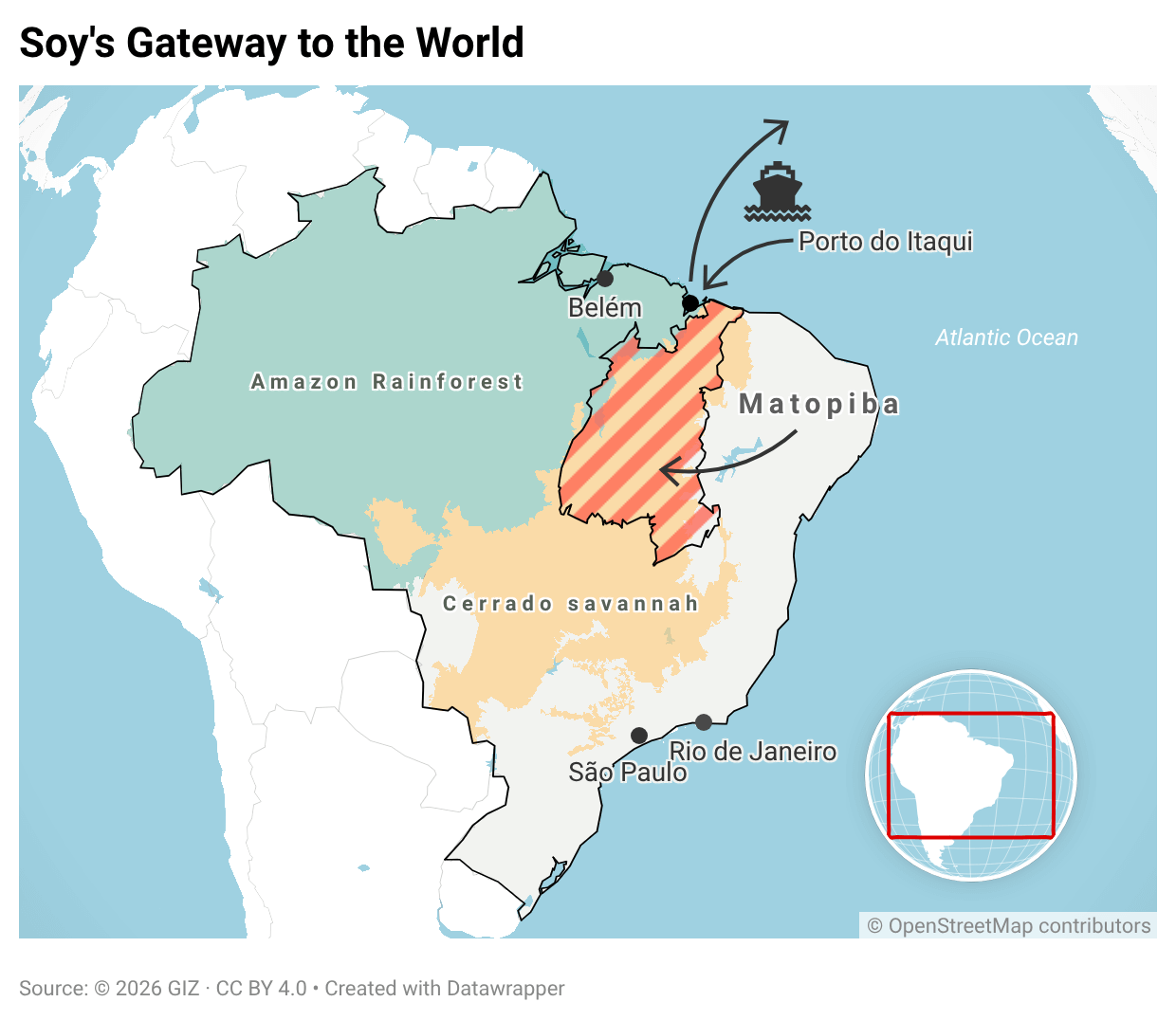
To understand where Brazilian soy comes from, we must trace it backwards. The journey begins at the endpoint: the port. Late afternoon in December at Porto do Itaqui in São Luís: around 28 degrees. Cranes move in measured arcs above a Panamax vessel, conveyors hum, and soybeans flow into the hold via a loading system operating in rhythm. A light cloud of dust rises above the hatch. The sound is a soft, continuous rush – betraying the true scale of what is being moved: the harvest of hundreds of farms in a single vessel. Nearly 14 million tonnes in 2024. Much destined for Europe.
Rainara Serra, ESG analyst, and Jaymerson Rodrigues, operations coordinator at CLI, place Itaqui in context: one of Brazil's most capable ports, part of the Arco Norte, the country's most dynamic export corridor. What flows through here tells a story. The harvest of hundreds of farms across MATOPIBA, the agricultural frontier spanning Maranhão, Tocantins, Piauí and Bahia.
"If you want to understand how soy reaches the world," Rainara says, "you have to understand how Itaqui works." Trade often appears abstract in Brussels or Berlin. At Itaqui, it becomes tangible. The port lies at the hinge between landscapes under pressure and global markets demanding ever more.

Inside the Control Room
Sustainability now shapes routing decisions, batch management and documentation. Origin certificates, satellite data and traceability codes accompany every consignment. With the EU Deforestation Regulation entering force, "deforestation-free" has become a market condition. "Transparency is no longer optional," Rainara says. "It allows Brazilian soy to remain competitive in international markets."
The following day, at the finance authority of Maranhão, officials demonstrated SIFMA, a monitoring system combining satellite imagery, geospatial analysis and producers' self-declarations. Every five days, new data flow in. Overlaps with protected areas or Indigenous territories are flagged. What sounds technical is profound: traceability anchored in public governance.
Yet technology alone does not resolve land conflicts. If soy expansion marginalises traditional communities, dialogue becomes essential. Trade policy and development cooperation must move in tandem.
Into the Hinterland
Travelling back from the coast into Maranhão's interior, the challenge becomes visible. The Cerrado, Brazil's vast tropical savannah, regulates rainfall far beyond its borders. Yet more than half its native vegetation has already been converted.
On family-run fazendas, producers speak less about export markets than soil. After months without rain, fields lie dry under a shimmering sky. Some experiment with crop rotation and reduced tillage. They work with universities to improve compliance with Brazil's Forest Code. Many insist they wish to be seen as custodians.
Their efforts are real. Yet they operate within an incentive structure shaped by global demand. Market signals from Europe matter. When buyers reward regenerative practices and verified compliance, they influence decisions thousands of kilometres away.
Beyond Soy: Where Livelihoods Depend on Forests
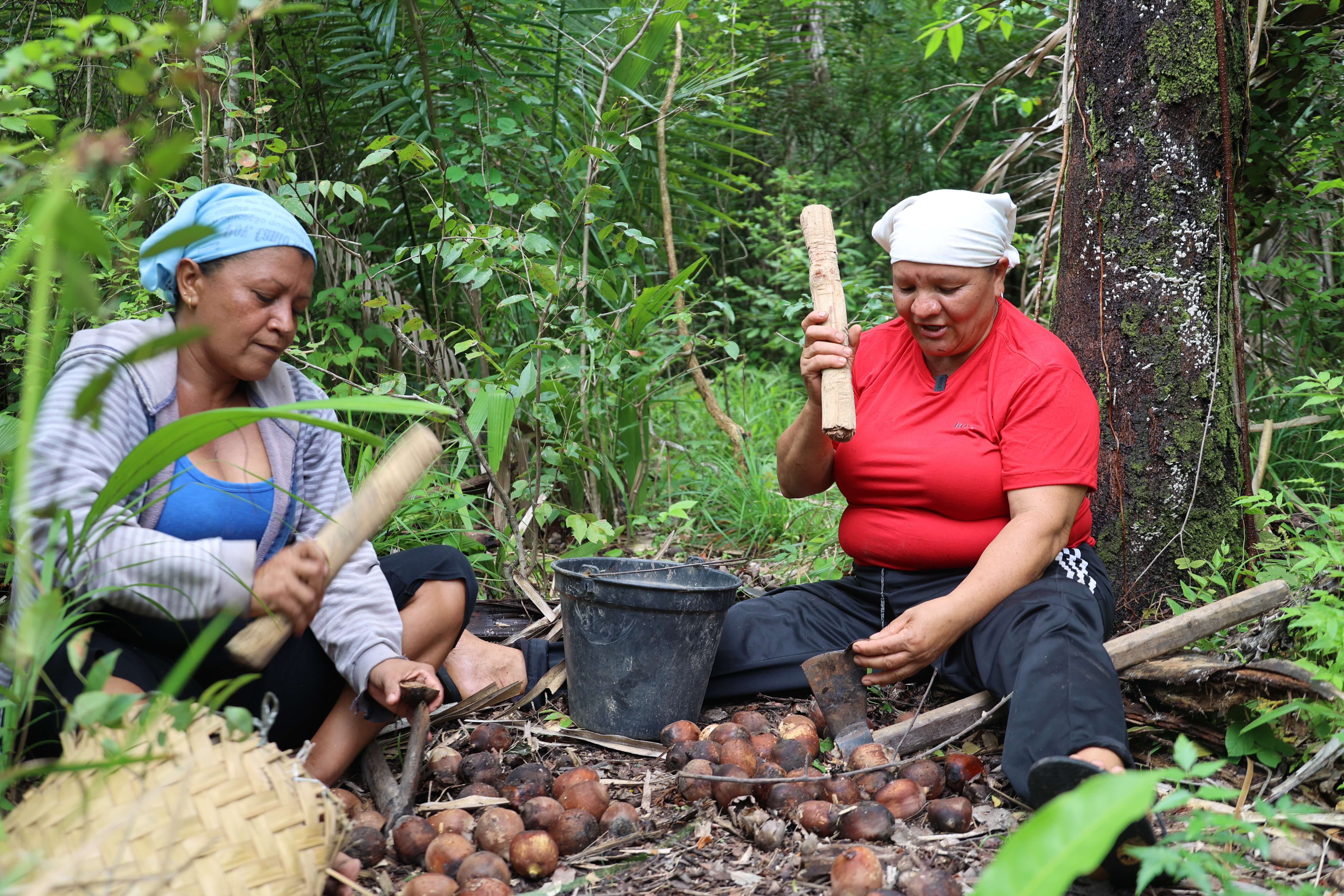
Beyond the soy frontier lie other value chains sharing the same landscapes. In a quilombola community in Maranhão, women harvest and process babassu, a native palm sustaining their families for generations. Women climb into the canopy to gather fruit, crack shells to extract nuts, press oil, grind flour. The income, modest but essential, supports schooling and healthcare for dozens of families.
This agro-industry depends entirely on standing forests. The palms grow interspersed among other trees, not in monoculture. The ecosystem itself, the water and soil and biodiversity, is what makes their work possible. When land is cleared for soy, women lose not simply income. They lose their connection to ancestral territories and to work that has shaped their communities for generations.
Further east, carnaúba palms provide wax for cosmetics and pharmaceuticals. Again, women carry much of the work, relying on deep knowledge and intact ecosystems.
These activities rarely feature in trade statistics. Yet they reveal an essential truth: agricultural supply chains are embedded in living territories where multiple livelihoods depend on the same land. EUDR aims to prevent deforestation. For women in quilombola communities, this framework carries urgent stakes. It determines whether their work continues or disappears.
When communities maintain economic viability through control of their territories, biodiversity is preserved. This is concrete: a woman harvesting babassu in a forest that will sustain her grandchildren, versus watching it converted to soy fields she will never see again.

Back at the Quay
Standing at the quay in Itaqui as dusk settles, the port seems calm. Yet every departing vessel carries more than grain. It carries regulatory choices in Europe, land-use decisions in Brazil and consumer expectations on both sides of the Atlantic.
For Germany and the European Union, Brazil is a strategic partner. How this trade is shaped determines its impact. Transparent systems and responsible actors, working with farming communities, determine whether trade advances sustainability.
If trade supports transformation, it must ask where soy is grown, under which conditions and alongside which other livelihoods. The global supply chain does not begin at the port. It begins in the Cerrado's red soils, in forests where women process babassu, in decisions of smallholder farmers, and in policies connecting field and vessel.
This article summarises a longer field report from Maranhão, tracing soy, babassu and carnaúba supply chains from port to landscape. The full report explores these connections in greater depth, documenting the voices and knowledge of the communities who shape these landscapes.