We can only benefit from technical progress if we have a solid legal framework. So far, none is in sight. Instead, international corporations grow ever more powerful.
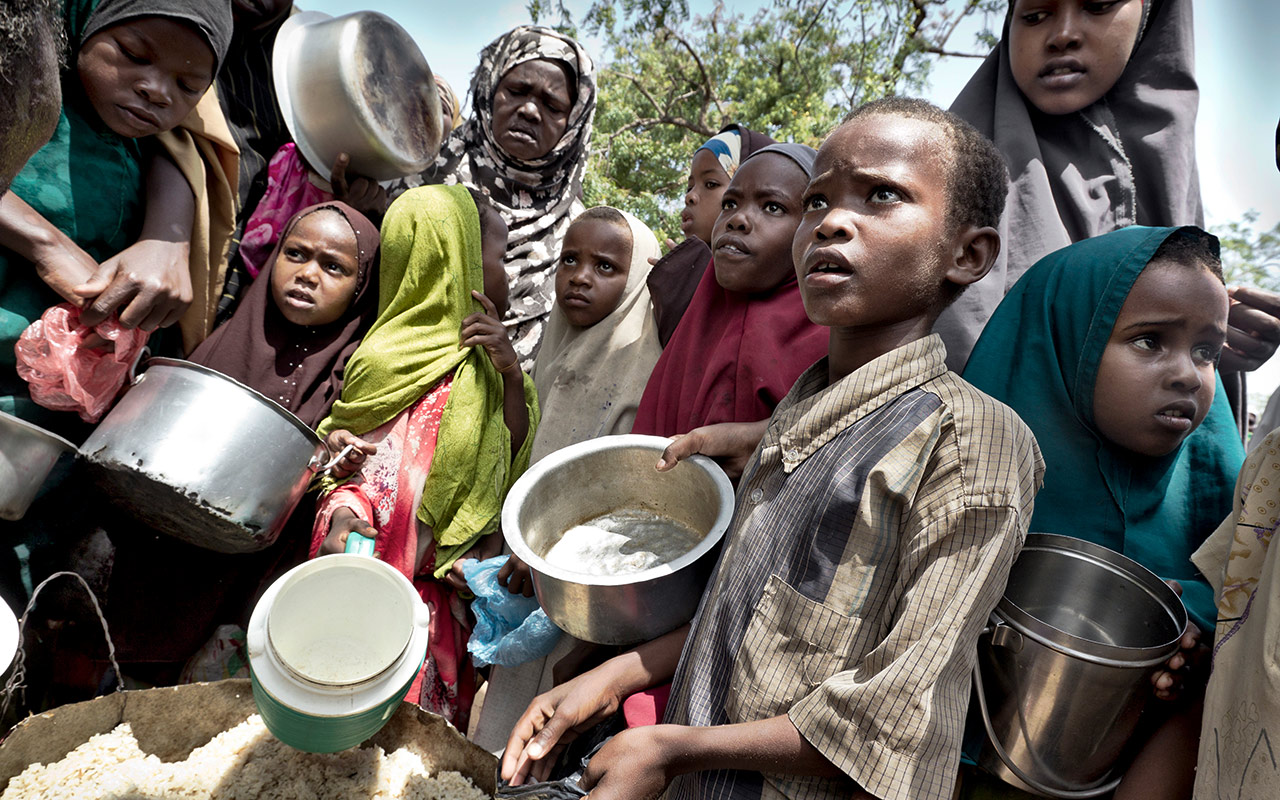
Somalia, Mogadishu: Refugees in camp Sagaal are waiting for their daily portion of rice. Photo: Christoph Püschner/Zeitenspiegel
Stig Tanzmann is a farmer and agricultural scientist and has been working as a consultant for agricultural issues at Brot für die Welt - Evangelical Developmental Service since 2010.
Many see the digital transformation of agriculture as a beacon of hope in the fight against world hunger and poverty— including the German Federal Ministry of Economic Cooperation and Development. In their brave new world, drones will help us record plant stocks, pests and crop yields more effectively, while the optimised application of chemical fertilisers and pesticides will boost the latter. Apps and chat groups will close the gaps in specialist agricultural consulting that opened due to the dismantling of governmental consultation structures carried out within the scope of structural adjustment programmes. Expectations in digital price information services and marketing management systems are similarly high: those advocating the digital transformation hope that it will rapidly solve structural agricultural and infrastructural problems in developing countries, setting off a development boom. Many private-sector players, especially digital and agricultural corporations, eagerly fan the flames of that hope. The Bayer-Monsanto corporation and others like it drive the development process forward and have designed their long-term business model with a digitised agricultural sector in mind.
Does the digital transformation of agriculture actually reach people suffering from poverty and hunger?
Oligopolistic structures already exist in many agricultural sectors that are the focus of the ongoing digitisation efforts—efforts that are promoted by corporations with an inherent interest in profits. This process is best known in the context of seeds and pesticides. Thanks to the digital transformation, these oligopolistic structures are ever closer intertwined and grow ever more powerful. The new, digital devices record the farmers’ every activity with timestamps: sowing, any application of pesticides and fertilisers, harvests, storage and distribution. Based on the data collected, many corporations endeavour to offer comprehensive solutions for the entire production chain. Wherever that is not an option, they collaborate with one or two other major corporations from other sectors. A partnership between a seed and pesticide producer, a manufacturer of agricultural machinery and a major dealer of agricultural commodities can be very profitable, for instance.
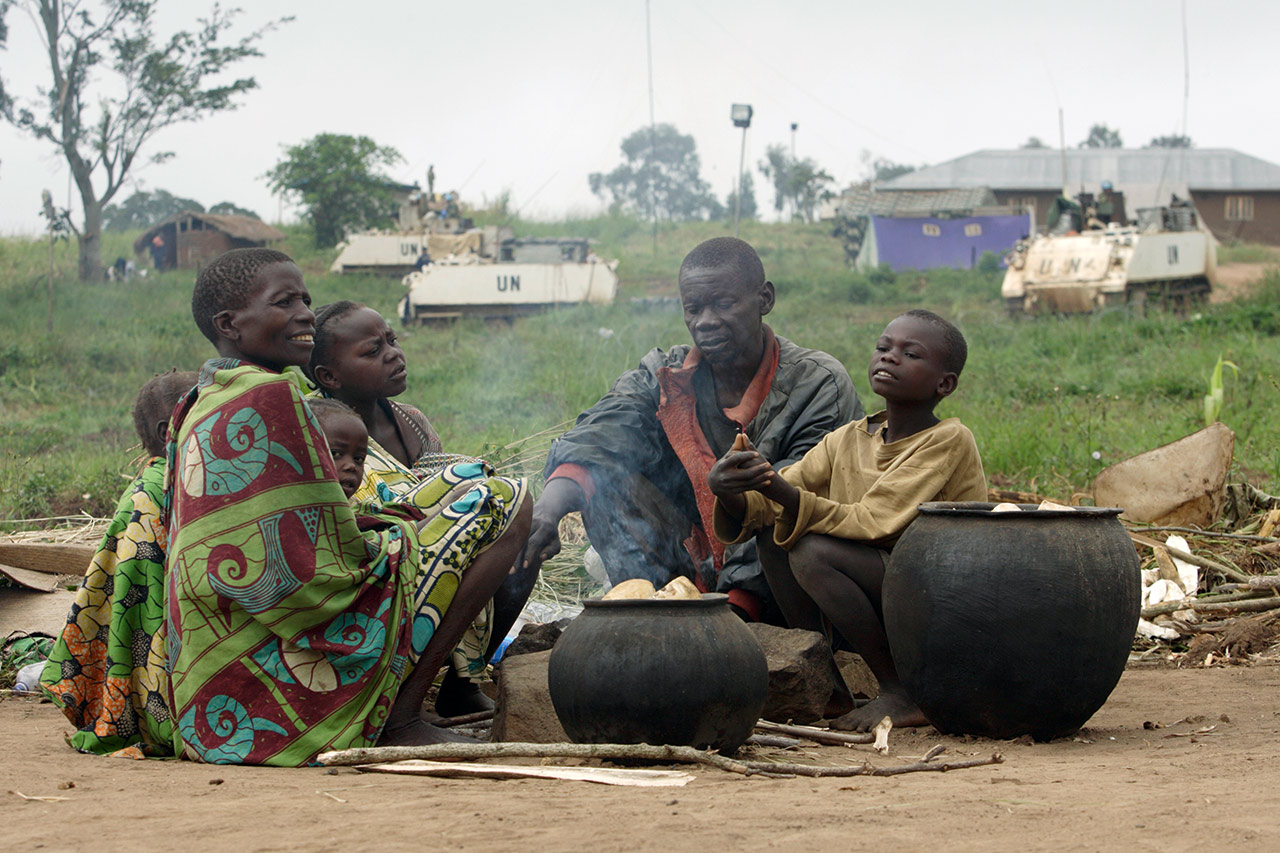
Kongo, Aveba: Refugees have sought temporary refuge near to a MONUC unity. Photo: Christoph Püschner/Zeitenspiegel
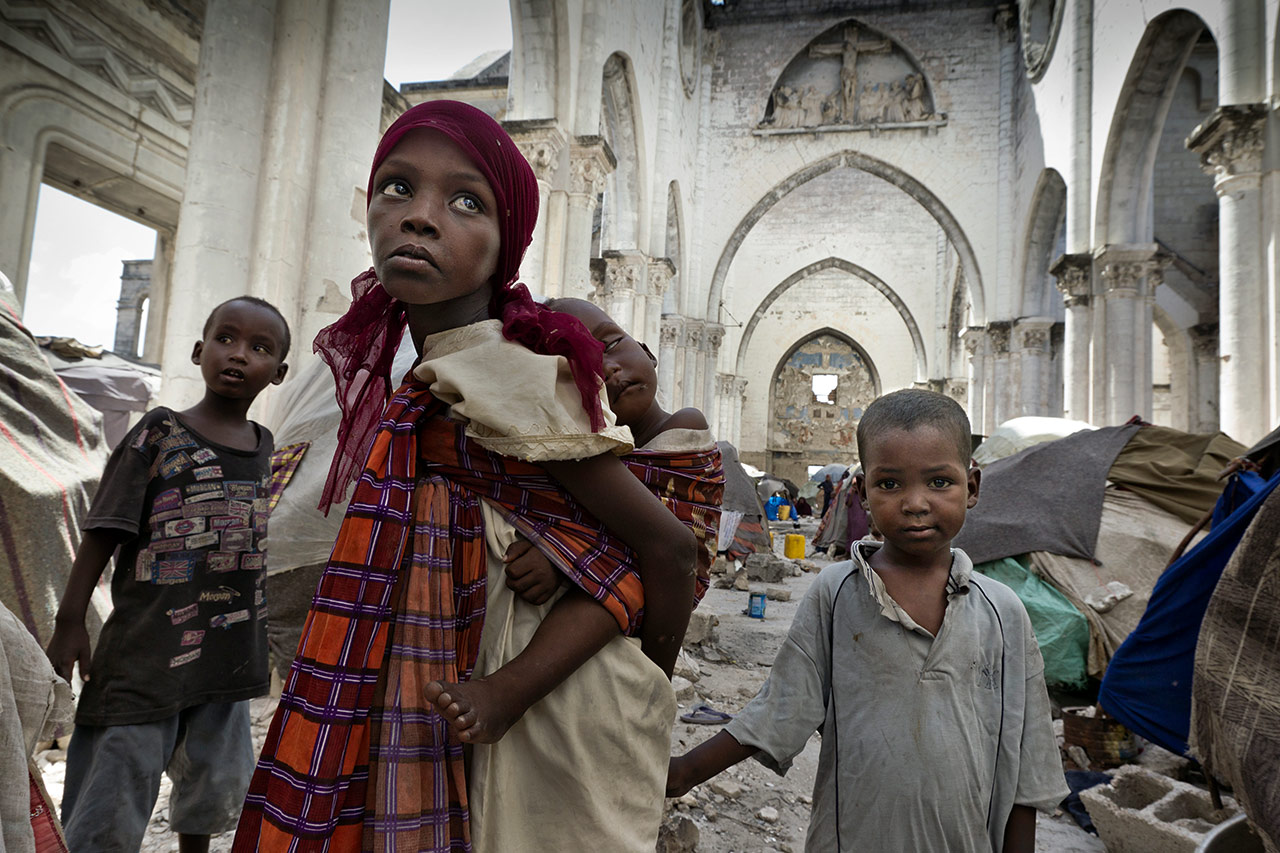
Somalia, Mogadishu: As a result of a severe drought, these refugees live in the ruins of the cathedral "Southern Cross". Photo: Christoph Püschner/Zeitenspiegel
Considering the substantial market power that corporations such as Bayer, John Deere, Cargill and Amazon already wield, it seems unlikely that any profits will trickle down to the poor population and the farmers themselves: they are, quite simply, the weakest links. Farmers also run the risk of being locked into the business models of the players that run these digitisation efforts: their access to consultation effectively becomes limited to services offered within the corporate frameworks. A Bayer app is unlikely to promote agroecological crop protection methods. The United Nations and the affected countries themselves must step up regulations for the digital transformation of agriculture in order to protect farmers from such risks and give them access to digitised structures in a way that strengthens their rights against corporations and national governments. The following section discusses a number of important regulatory approaches. They are issues that cannot be solved without first determining who currently benefits from digitisation.
Leave no one behind: digital transformation and the UN Sustainable Development Goals
The current hype around the digitisation of agriculture in international development seems to suggest the emergence of a new phenomenon. That is not the case. Certain studies on the current state of the digital transformation in the agricultural sector, including some commissioned by the Food and Agriculture Organization of the United Nations (FAO), have produced worrying results: far from bridging it, digitisation deepens the gap between the industrial and developing nations, between urban and rural areas, men and women. In order to use the new, digital structures in the first place, people need a basic infrastructure and a compatible device. This, in turn, requires considerable financial resources and reliable access to electricity and a network connection. Rural regions of developing countries, in particular, have struggled (and failed) to meet these requirements for decades. Women frequently lack access to money. This complicates their independent access to the digital world or prevents it entirely. As a result, the digital transformation simply does not reach many female farmers in rural areas. Considering the UN Sustainable Development Goals (SDGs) and their mantra, “Leave No One Behind”, however, they are a particularly important target group.
It is important to keep in mind that 50 per cent of the global population do not have access to the internet. In the least developed countries, only 17.5 per cent of citizens use the internet at all. These figures should be enough to make us pause and think about the conditions that must be put in place to create a digitised agricultural sector that can genuinely help people living in poverty and suffering from hunger. We must ask ourselves: does the digital transformation worsen social inequality? What relevant insights do we already have in the context of international development?
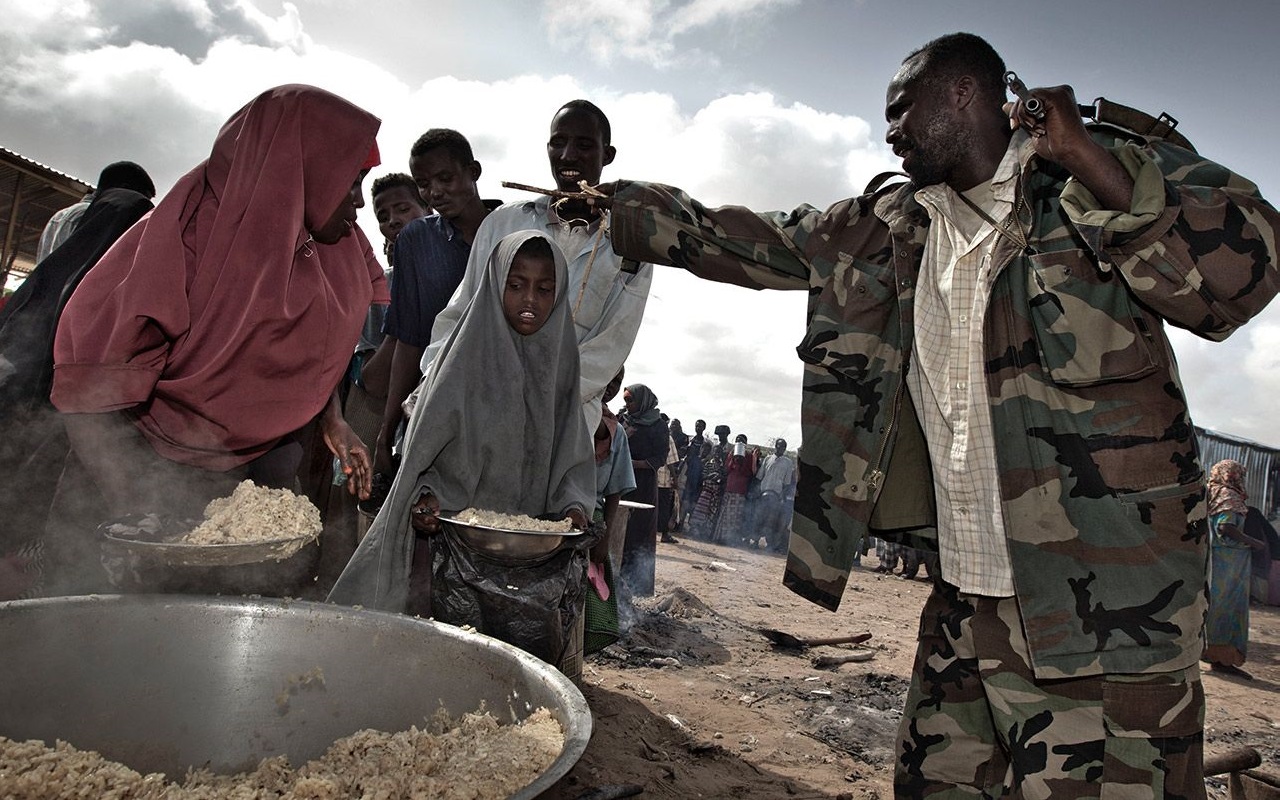
Kongo, Aveba: displaced families, fled in fear of the government troops and heavily armed guerilla groups. Photo: Christoph Püschner/Zeitenspiegel.
A British study from 2018 explores that very topic. Its conclusion: far from reducing inequalities, digitisation in its current form reinforces them. The authors list a large number of problems that cause disadvantages for people living in poor, rural areas.
In light of those problems, it is crucial that we find a way to help disadvantaged communities exercise their rights. This explicitly applies to the project of digitising agriculture.
The digital economy revolves significantly around the corporate utilisation and evaluation of data. Digital applications developed by corporations to provide farming and marketing advice (fertilisation, crop protection etc.) are often free or nearly free to use; in turn, they feed the corporate programmes with relevant operating data. The providers use these data as a basis for expanding and optimising their programmes and services and, ultimately, gain more and more influence on the market. They then hope to sell their applications for ever-increasing profit. The data produced by agricultural businesses, then, constitute a future financial asset for corporations. Before using the digital products, farmers are asked to consent to their general terms and conditions—and to the processing and further utilisation of their data. They effectively give up the rights to their own data. What exactly the acceptance of said terms and conditions may entail is yet to be seen. In a worst-case scenario, corporations might copyright certain peasant practices, such as the traditional treatment of seeds with cow urine, thus preventing the farmers from using their traditional knowledge without restrictions.
Human rights and the law in the digital transformation of agriculture
This is highly problematic from a human-rights point of view. A lot of the data collected about seeds and growing techniques constitute traditional or peasant knowledge, which various legal contexts deem especially worthy of protection. The data also form the basis of the farmers’ entire production systems, and they are given up to corporations that embody an industrial, rather than agricultural, production system. This could create another gap to the detriment of farmers. Digital applications are developed primarily with industrial systems in mind, which prescribes a certain development to the farmers using them. This lock-in effect, of course, largely benefits the corporate players behind the applications.
The United Nations has established legal frameworks for the protection of peasant and traditional knowledge. If these frameworks were to be made concrete and adopted as national laws, they could curtail the corporations’ currently unrestricted access to the peasant data they so crave. Both the UN Convention on Biological Diversity (e.g. Article 8) and the FAO International Seed Treaty (Article 9: Farmers’ Rights) demand that all signatories develop and pass legislation to protect peasant and traditional knowledge. Their purpose is to prevent the abuse and commercialisation of said knowledge by third parties without the explicit consent of those affected. Consequently, the general terms and conditions of digital applications should be phrased completely differently and revolve around the protection of peasant knowledge.
The purpose of the aforementioned treaties is to ensure that said knowledge remains a common resource available to all. Both aim to achieve that goal by means of regulations governing access to (digital) resources and benefit sharing. In this system, it would be up to farmers to decide whether to grant access or use the application without consenting to the utilisation of their data. For the providers, this would mean offering multiple options. If they do grant access, they would be required to share the benefits in turn, ensuring that peasant knowledge is preserved and strengthened as a common resource. Unfortunately, the competent legislators have failed to develop such laws in the past years.
At the same time, both treaties have unleashed a fierce argument between the Global North and the Global South: does the established mechanism governing access to genetic resources and benefit sharing (ABS) also apply to digital sequence information (DSI), i.e. digital information derived from analogue genetic material? The heated disagreement between the signatories emphasises the close relationship between the two treaties, the digital transformation and its legal frameworks.
Many nations have acknowledged their failure to protect traditional knowledge sufficiently. In 2018, the UN Peasant Rights Declaration once again underscored the necessity to protect said knowledge. Both the German government and the Federal Ministry of Economic Cooperation and Development, in particular, must respond by stepping up their implementation of the legislative duties laid down in the International Seed Treaty—and helping other countries follow suit.
Kongo, Kinshasa: Growing techniques and traditional cultivation method are considered as worthy of protection. Photo: Christoph Püschner/Zeitenspiegel
A valid first step would be for the Ministry to commission a study that includes political recommendations. It should focus on ways of implementing the duties laid down in the Convention on Biological Diversity and the International Seed Treaty for protecting traditional and peasant knowledge in a legally binding manner that can be applied to the digital transformation. The 2015 study “The UPOV Convention, Farmers' Rights and Human Rights” by the GIZ could provide a useful model or guiding framework. This would be an important step towards implementing laws that can protect peasant knowledge in the context of the digital transformation.
But legislation is lagging far behind on other issues, too. Many African countries, including Kenya, lack data protection laws for personal data. Even the collection of data by the state is extremely controversial there. To complicate matters further, it is often impossible to guarantee that the data are stored in the same country where they were collected. At the moment, 90 per cent of data about Africa are stored in Europe or North America, i.e. in different legal frameworks. This is a major crisis of sovereignty for countries as well as peasants. How can they exercise control over their own data if said data are stored in other countries, under different laws?
Digitisation can and must contribute to eradicating poverty and hunger
The opportunities inherent to the digital transformation of agriculture are doubtlessly significant, and we must use them in a meaningful way that reduces poverty. This requires us to evaluate current development critically and tackle the problems discussed in this article. Examining the effect of our own projects on poor and disadvantaged communities is essential.
If we want the digital transformation of agriculture to take place in a constitutional manner and prevent farmers’ data and their rights to that data from falling into the hands of corporations, solid data protection laws are required as a minimum standard. We also need laws that protect peasant knowledge. There must be sufficient capacity to store data in the countries where it is collected, and that capacity may need to be established first. The same demand has been voiced by sections of Africa’s civil society already. Only if the data stay in their country of origin can we ensure that the right to those data can be exercised.
These fundamental frameworks are necessary to ensure that the digital transformation of agriculture can be implemented in a way that benefits farmers and poor and disadvantaged communities.
A world without hunger and with sufficient healthy food as well as climate-friendly agriculture can only be achieved if ideas are transformed into innovations and ultimately also applied - a conversation with BMZ Head of Division Sebastian Lesch on the Innovation Challenge programme of the new Agricultural Innovation Fund.
Peasant farmers tend to fail due to bank credit limits. But investment could help them generate a sustainable income. This has given rise to an intense discussion about potential digital solutions.
Does Africa's youth want to live in the city or in the country? Which career path seems particularly attractive? And how optimistic are the young people about the future? Young adults from rural areas answered these questions by SMS.
Shortly before ending his position as Director General of the International Food Policy Research Institute (IFPR) Dr. Shenggen Fan talks about the reforms and new modes of operation needed to achieve global food security in the coming decade.
Small farmers in developing countries must modernise their farming methods, but poorly understood reforms could exacerbate poverty instead of alleviating it.
In western Africa a new middle class is emerging. Their consumer behaviour is determining the demand for products – home-produced and imported goods, on the internet or at the village market. The people of Ivory Coast in particular are looking to the future with optimism.
A report by T. S. Jayne, A. Adelaja and R. Mkandawire
Thirty years ago, Africa was synonymous with war, famine and poverty. That narrative is clearly outdated. African living standards are rising remarkably fast. Our authors are convinced that improving education and entrepreneurship will ensure irreversible progress in the region even as it confronts COVID-19.
Startups are booming in African agriculture. What are the current trend and challenges – and can other regions benefit from innovative approaches? A Video-Interview with Claudia Makadristo, Regional Manager of Seedstars
International agricultural research is responding to new challenges: Their advisory group is undergoing a fundamental reform process and unites knowledge, partnerships and physical assets into OneCGIAR.
Artificial intelligence, big data and blockchain are the hottest topics of our time. The digital transformation of the African agricultural sector is ready for take-off. What will it take for the future of technology to hit the ground running?
Lots of apps are entering the market, but what really makes sense? For African agriculture, some of it seems like a gimmick, some like a real step forward. So this is what a smallholder farm in Africa could look like today - with the help of smartphones, internet and electricity.
It is 2080. We are on a farm somewhere in Africa. Everything is digital. The blockchain is an omnipotent point of reference, and the farm is flourishing. But then, everything goes wrong. A dystopian short story, written exclusively for SEWOH.
Jehiel Oliver was a successful consultant. One day, he quit his job in investment banking to become a social entrepreneur. His mission: tractors for Africa. Rental tractors. What gave him that idea? Find out in his interview with Jan Rübel.
A contribution by Sarah D´haen & Alexander Müller, Louisa Nelle, Bruno St. Jaques, Sarah Kirangu-Wissler and Matteo Lattanzi (TMG)
Young farmers’ insights on the effects of the COVID-19 pandemic on food systems in Sub-Saharan Africa @CovidFoodFuture and video diaries from Nairobi’s informal settlements.
At the moment, the agricultural industries of African countries exist in relative isolation. Imagine peasant farmers digitally connected to the value chains of the global food industry. How could this happen? A guidebook.
There is a clear global task: We need to feed nine billion people by 2050. We, the people of Earth, must produce more food and waste less. That is the top priority of the UN World Food Programme (WFP), too - the description of a challenge.
At the beginning of December 2018, AGRA's board of directors met in Berlin. The "Alliance for a Green Revolution in Africa" panel discussed the next steps in their policy of modernizing agriculture. How to go on in the next ten years? One question - many answers from experts.
Joe DeVries is a breeder – and Vice President of AGRA (Alliance for a Green Revolution in Africa). What are the chances and risks of a ’green revolution‘ in Africa? A discourse between Jan Rübel and him about productivity, needs, and paternalism.
Stefan Liebing is chairman of the Africa Association of German Business. The manager calls for a better structure of African farms. Jan Rübel asked him about small farmers, the opportunities for German start-ups and a new fund.
The project “Scaling digital agriculture innovations through start-ups” (SAIS) supports Africans going into business in the agricultural and food sector in scaling their digital innovations and thus reaching out to a larger number of users.
Africa has a huge opportunity to make agriculture its economic driver. However, the potential for this is far from being made exhaustive use of, one reason being that women face considerable difficulties in their economic activities. The organisation AWAN Afrika seeks to change this state of affairs.
The COVID 19 pandemic is hitting developing and emerging countries and their poorest populations particularly hard. It is important to take countermeasures at an early stage. Companies in the German agricultural sector want to make their contribution to ensuring the availability of urgently needed operating resources.
The region of Sub-Saharan Africa is on the decisive verge of a great development boost in farming: it could skip entire generations of technological development. But how? About possible roles and potentials of digital services.
Stig Tanzmann is a farmer and adviser on agricultural issues at ‘Bread for the World’. Jan Rübel interviewed him about his reservations about AGRA's strategy.
What do electrical engineering, telecommunications and agriculture have in common? They arouse the passion of Strive Masiyiwa: Thirty years ago, he started an electrical installation company with $75, later riding the telecommunications wave as a pioneer. Today he is committed to transforming African agriculture.
Climate change is destroying development progress in many places. The clever interaction of digitalisation and the insurance industry protects affected small farmers.
A new study on the digitalisation of agriculture puts farmers back at the centre of their own sector, identifies market gaps and gives recommendations on how to support relevant actors.
VR glasses are hardly a conventional tool in agriculture: for the past three years, they have been used in rural areas of Burkina Faso and Cameroon as a training tool for sustainable cotton cultivation.
Studies show that women often manage agricultural resources more effectively and sustainably. With equal access to production resources, agricultural yields could increase by up tp 30 per cent. But this is about more than just productivity. How can gender-transformative approaches (GTA) drive meaningful change and why are GTA key to sustainable change?
“In times of global crises and growing budget constraints, strong partnerships are more crucial than ever” – this statement by Federal Minister Alabali-Radovan in the German Bundestag in mid-May is also a guiding principle for the German Agribusiness Alliance. For greater cooperation between politics and the private sector in development cooperation, writes Director Dr. Per Brodersen.
Small holders around the world are often forced to sell their harvests below market value due to a lack of market and pricing information. A new app by the UN World Food Programme (WFP) is going to change this.
What Africa is experiencing in the course of digitisation is a disruption. Here three steps are taken in one, there you remain. In any case, the changes are enormous and bring some surprises. A graphic walk.
A Contribution by Initiative für nachhaltige Agrarlieferketten (INA)
The demand for sustainable products and supply chains is constantly increasing. DIASCA is an alliance that works on interoperability of digital solutions in agricultural supply chains through the development of open standards for forest monitoring, farm income and traceability.
This is a benchmark for everybody: More rights for women are a very influencing solution in the struggle against extreme poverty and hunger worldwide, says Stephan Exo-Kreischer, Director of ONE Germany. The organisation specialises in political campaigning as a lever for sustainable change.
Countries across Africa coordinate their efforts in the fight against corona by the Centre for Disease Control (CDC) of the African Union in Addis Abeba. Until now, the curve of new infections has been successfully flattened – why? Dr. Ahmed Ouma, Deputy Director, explains the work of CDC in an interview with Tilman Wörtz.
Every year in October, the "Welthungerhilfe" aid organisation, with the Irish "Concern Worldwide" NGO, publishes the Global Hunger Index, a tool with which the hunger situation is recorded. What are the trends - and what needs to be done?
Over a period of two years, the Ceres2030 team spent researching answers to the questions of how much it will how much it will cost to realize SDG 2 and where that money should be spent most effectively. IISD Senior Advisor and Ceres2030 Co-director Carin Smaller about small farmers, machine learning and women empowerment.
The CGIAR agricultural research organization is systematically repositioning itself. We spoke with Juergen Voegele, Vice President for Sustainable Development at the World Bank, about progress to date - and discuss what needs to be done collectively to stop global hunger in ten years.
In August, Germany’s development ministry set up a division concentrating on One Health topics. Parliamentary State Secretary Maria Flachsbarth on knowledge gaps at the human-animal-environmental interface, the link between One Health and food security, and lessons learnt from previous pandemics.
A contribution by Heike Baumüller, Christine Husmann, Julia Machovsky-Smid, Oliver Kirui, Justice Tambo
Any initiative whose aim is to reduce poverty in Africa should focus first on agriculture. But what kind of investment has the greatest impact? The use of scientific criteria provides some answers.
Financial innovations can prevent a crisis turning into a catastrophe. The livelihoods of people in affected areas may well depend on intervention before a crisis – and on risk funds.
Innovation is the only way to end hunger worldwide by the deadline we have set ourselves. The secret lies in networking and sharing ideas – and several initiatives are already leading by example.
After four years of Donald Trump in the White House, it is time to take stock: What policies did the Republican government pursue in African regions? And what will change in favor of Joe Biden after the election decision? Here is an evaluation.
The Global Agriculture and Food Security Program (GAFSP) was launched by the G20 countries in 2010 in response to the 2008-09 food price crisis to increase both public and private investment in agriculture. An overview of the programme's approach, results and impact.
Even though COVID-19 poses a threat to the health of humanity, the reaction to the pandemic must not cause more suffering than the disease itself. This is particularly relevant for poor developing countries, where the impact of the corona crisis on food security is even more severe!
Corona makes it even more difficult to achieve a world without hunger by 2030. So that this perspective does not get out of sight, Germany must play a stronger role internationally - a summary of the Strategic Advisory Group of SEWOH.
In most African countries, the infection COVID-19 is likely to trigger a combined health and food crisis. This means: In order to cope with this unprecedented crisis, consistently aligning our policies to the Sustainable Development Goals (SDGs) is more important than ever, our author maintains.
COVID-19 has unprecedented effects on the world. As always, the most vulnerable are the hardest hit, both at home and - especially - abroad. A joint appeal by the German Federal Ministry for Economic Development and Cooperation (BMZ) and the Department for International Development (DFID).
What contribution does development cooperation make to conflict prevention? What can it do for sustainable peace? Political scientist Karina Mroß talks to Raphael Thelen about post-conflict societies and their chances for peaceful development.
The Cashew Council is the first international organisation for a raw material stemming from Africa. The industry promises to make progress in processing and refining cashew nuts - and answers to climate change
Enabling smallholders to trade across regions and borders promotes food security and economic growth. Although everyone is calling for exactly that, implementation is still difficult
Agnes Kalibata, AGRA president since 2014 and former minister of agriculture and wildlife in Rwanda, is convinced that Africa's economy will only grow sustainably if small-scale agriculture is also seen as an opportunity.
Nutrition experts from all over the world are coming together in Rome. They are not only distilling 2000 ideas to improve food systems - they are also preparing for the big UN summit in New York in September. An interview.
Journalist Jan Rübel spoke with Joao Campari ahead of the UNFSS Pre-Summit. The Chair of Action Track 3 highlights key challenges in transforming existing food systems towards sustainable production and shares his expectations for the Summit.
Interview with Paul Newnham, Director of the SDG 2 Advocacy Hub.
The UN Food Systems pre-Summit in Rome dealt with transforming the ways of our nutrition. How do you bring that to a broad public? Questions to Paul Newnham, the Director of the Sustainable Development Goal (SDG) 2 Advocacy Hub.
Interview with Martina Fleckenstein (WWF), Michael Kühn (WHH) and Christel Weller-Molongua (GIZ)
After the summit means pre-summit: It was the first time that the United Nations held a summit on food systems. Martina Fleckenstein, Michael Kühn and Christel Weller-Molongua reviewed the situation in this joint interview.
From a circular food system in Rwanda to functioning cooled transports in Kenya: The lab of tomorrow addresses development challenges such as preventing food loss and waste
In Zambia, innovative approaches are used to address the problem of post-harvest losses in the groundnut value chain. GIZ's Rapid Loss Appraisal Tool (RLAT) can help to develop more such approaches.
Three quarters of the world's population do not have secure land rights, which hinders investment and innovation. The project "Improvement of Livelihood and Food Security" supports smallholder farmers in acquiring land.
The climate crisis fuels world hunger. What needs to change in the global fight against hunger, and which role plays humanitarian aid in international development cooperation?
In March 2022, the virtual conference ICTforAg summons leading actors in the agrartechnology and food sector from low- and middle-income countries to exchange ideas advancing resilience, nutrition and agriculture-led growth.
Climate change already affects the daily lives of people in the Global South. What are the challenges they face and what do these imply for negotiations at the climate conference in Glasgow?
In the run-up to the G7 summit, experts from politics and civil society discussed sustainable and more effective options for action by the G7 states to combat hunger.
Development cooperation needs to place good governance and a sustainable agri-food systems transformation at its center: After the first 100 days in office have passed, Dirk Meyer from the German Development Ministry (BMZ) spells out the goals, guidelines and priorities of the Ministry’s new lead.
New insights on trade and value addition in the rice sector in West Africa
Low import tariffs, smuggling activities, unpredictable tax exemptions and weak enforcement of food safety standards: The potential of local rice value chains is undermined in West African countries.
The oceans are important for our food supply, but they are overfished. To halt this trend the global community is now taking action against illegal fishing. Journalist Jan Rübel spoke with Francesco Marí, a specialist for world food, agricultural trade and maritime policy at "Brot für die Welt," and others.
When women have control over the resources of a household and manage the income, it usually leads to a more balanced and healthier diet for the family. But often the decision-making power lies with the men. How can this gender inequality be addressed? The GIZ global project Food Security and Resilience provides insights into project work on gender-transformative approaches finances by the Federal Ministry for Economic Cooperation and Development (BMZ).
Four interviews kick off the relaunch under the new name „Food4Transformation“, asking the same questions from different perspectives. Dirk Meyer, Federal Ministry for Economic Cooperation and Development, thinks: less individual solutions are needed, but more systemic approaches. Because in addition to the goals for food security, the issues of climate and biodiversity must also be taken into account.
A Contribution by the Federal Ministry for Economic Cooperation and Development
At the network meeting "Partners for change - Transformation to a food secure, resilient and sustainable future", almost 250 participants from over 20 countries came together to exchange experiences and ideas on the transformation of agricultural and food systems. The final product, joint recommendations to transform agricultural and food systems, can now be read online.
Halfway through the 2030 Agenda, the BMZ invited participants to a network meeting entitled "Partners for change - Transformation to a food secure, resilient and sustainable future". Experts from around the world developed recommendations in a consultation process and then consolidated them in Berlin. A site visit.
A Contribution by Harry Hoffmann (TMG) & Nathalie Demel (WHH)
At the halfway mark of the 2030 Agenda and two years after the UN Food System Summit 2021, a stocktaking moment was held in Rome to analyze the progress of countries on the commitments to action in transforming food systems. Dr Harry Hoffmann, TMG Think Tank, and Nathalie Demel, Welthungerhilfe, were on site and take stock as well.
A contribution by the Global Donor Platform for Rural Development
Two years following the UN Food Systems Summit, the Global Donor Platform for Rural Development and the Shamba Centre for Food & Climate hosted an official side event at the UNFSS+2. The event explored how public donors can increase the impact of their investments.
It takes the joint efforts of diverse actors to achieve a transformative impact on the global food system. Barbara Rehbinder, Scaling Up Nutrition Movement (SUN), discusses four people-centred principles to get closer to this goal.
Chancellor Angela Merkel in the Podcast of the Federal Government
At the start of World Food Week around World Food Day on 16 October, Chancellor Angela Merkel stressed that the fight against global hunger will only be successful with international responsibility and solidarity (german only).
The Agriculture and Food Security Cluster of the Deutsche Gesellschaft für Internationale Zusammenarbeit (GIZ) GmbH in Zambia shows how synergies among different projects and partner organisations can help people to eat healthier, diversified food. A delegation of the Bonn based Division of Agriculture and Rural Development learned this in a field visit in the Eastern Province of the Southern African country.
Every second, worldwide, we lose valuable and healthy soil with the size of four football fields. This was only one of the many facts being presented to a wide audience in Bonn and worldwide via livestream at the World Desertification and Drought Day on 17th June 2024. This was the 30th anniversary of the United Nations Convention on Combatting Desertification (UNCCD), which was celebrated at the Bundeskunsthalle in Bonn.
In Himachal Pradesh, India, natural disasters are becoming more frequent and climatic conditions are changing – with negative consequences for apple production and farmers' livelihoods. Holistic and multidimensional innovation bundles are required for the entire value chain in order to make the food system more resilient in the future.
From January 9 to 11, 2025, heads of state and government of the African Union met in Kampala, Uganda. With a clear vision and concrete measures, the Kampala Agenda aims to make the continent's agricultural and food systems climate-resilient, fair and future-proof by 2035.
The bioeconomy movement is fundamentally changing agriculture and food production: through innovative ideas, environmentally friendly approaches and the realization that we need to work together globally to ensure that change truly benefits everyone. At this years’ German Forum for Food and Agriculture (GFFA), the German Federal Ministry for Economic Cooperation and Development (BMZ) focused on this topic.
In 2025, GIZ and the Import Promotion Desk (IPD) celebrate ten years of successful cooperation. With their joint stand at BIOFACH trade fair in Nuremberg, they were able to introduce over 300 organic companies of partner countries to the European market. And the journey continues – despite challenges on the global market.
With a simple but effective idea to combat malnutrition: in Nairobi, Fabio Rappenecker and his start-up TenX Nutrition produce mandazi, which become a real power biscuit thanks to added micronutrients. The aim is to strengthen food security through local, affordable and healthy food.
In a new study, the international humanitarian agency CARE analyses how the economic and social barriers faced by women significantly reduces the global gross domestic product (GDP). At the current rate, it will take 152 years to close the economic gap between women and men – although closing this gap would be extremely profitable from an economic perspective.
In May, this year's "Partners for Change – SOILutions for a Food Secure, Resilient, and Sustainable Future" conference took place. Kah Walla, Moderator of the Conference and Director of Strategies!, summarises the discussions and declares that healthy soils are not just the foundation of agriculture, but the cornerstone of a resilient, equitable, and climate-smart future.
A Contribution by Carlos Castellanos & Yvonne Bielfeld
The shoe manufacturer Cueros Vélez as a good example of private sector responsibility: the photo gallery shows how the bark of the rubber tree becomes a reliable yet deforestation free companion on our roads.
For everyone in the supply chain to benefit, it is essential that politics and business work together. The measurable successes of such partnerships are demonstrated by the following six projects: they show how cooperation with the business sector can make supply chains fairer, more resilient, and more sustainable step by step.
The future of agriculture lies in the hands of young people. Genna Tesdall from the International Netwrok Young Professionals for Agricultural Development (YPARD) discusses what they need.
20 years of international engagement, 10 years of successful collaboration with Deutsche Gesellschaft für Internationale Zusammenarbeit (GIZ) GmbH. Andreas Hermes Akademie (AHA) has achieved a very special milestone and invited partners to discuss what has worked in the past and what is needed in the future to create resilient agricultural and food systems.
Every child in Germany knows Ritter Sport – but most of the children harvesting cocoa on western African plantations have never even eaten chocolate. Can a chocolate manufacturer change the world? Conversation with Alfred Ritter about the power and powerlessness of a businessman.
A quick and cost-effective method calculates living wages and incomes for many different countries. The GIZ together with Fairtrade International and Richard and Martha Anker have developed a tool that companies can use to easily analyse income and wage gaps.
Oxfam’s supermarket scorecard, which is in its third year, shows one thing in particular - it works! Supermarkets can change their business policies and focus more on the rights of those people around the world who plant and harvest food. However, this does not happen without pressure.
The Federal Government is fine-tuning a law that would require companies to ensure human rights – a supply chain law. What are the consequences for the agricultural sector? Dr Bettina Rudloff from the German Institute for International and Security Affairs (SWP) discusses linking policy fields with added value.
Why aren’t bars of chocolate made where cocoa is grown? Author Frank Brunner analyses the industry’s fragile value chain from the plantation to the supermarket
‘Fair’ and ‘sustainable’ are key words in Germany’s EU Council Presidency. At the same time, Germany pursues ‘modernization’ of the WTO and ‘rapid progress’ on free trade agreements. Are these goals really compatible? Can we be concerned about fairness and sustainability while continuing with ‘business as usual’?
As President of the IABM cooperative in Muhanga, Alphonsine Mukankusi is not simply focused on the figures. She has learned how to deal with people and how to take on responsibility. At the same time, her work helps her to come to terms with the past
A report by Bettina Rudloff and Annette Weber (SWP)
The Corona-Virus exacerbates existing crises through conflict, climate, hunger and locusts in East Africa and the Horn of Africa. What needs to be done in these regions? To face these challenges for many countries, all of these crises need to be captured in their regional context.
In the tropics rainforests are still being felled for the production of palm oil, meat and furniture. It is high time to act. Proposals are on the table.
At the 8th German-African Agribusiness Forum (GAAF) representatives from business and politics discussed successful investment models to improve living conditions in Africa.
Based on a scientific study by TMG Think Tank, the authors highlight various challenges in the fight against the hunger crisis. The findings show that climate change, conflict and covid-19 are increasing food and energy prices.
The Africa Agriculture Trade Monitor 2022 (AATM) was published by IFPRI and AKADEMIYA2063. The report analyses the short- and long-term trends and drivers of African agricultural trade flows, including regional policies and the role of global markets.
An Artikel by the Initiative for Sustainable Agricultural Supply Chains (INA)
A study published by the Deutsche Gesellschaft für Internationale Zusammenarbeit (GIZ) examines the differences between globally traded agricultural commodities and domestic niche products in terms of economic, environmental and social impact on the region of origin. The results provide new evidence to make supply chains more sustainable.
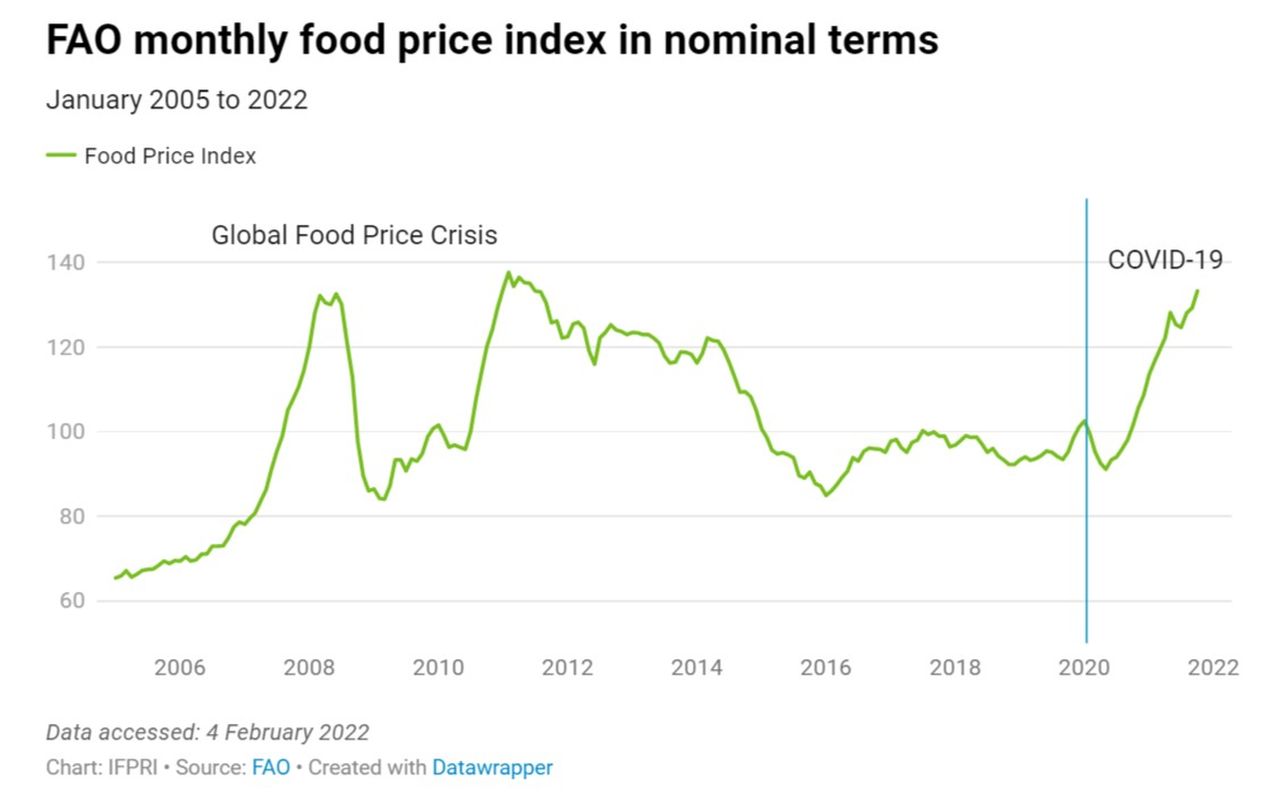
Taking a look at the data (as of February 11th 2022) what the current price hike means for world hunger and what can be done to prevent from another food crisis.
Until Easter 2022, GIZ publishes a new episode every fortnight introducing people who are committed to fair and sustainable cocoa in Côte d'Ivoire and Germany.
A Contribution of the 'Initiative for Sustainable Agricultural Supply Chains' (INA)
Fair Trade organisations and the Initiative for Sustainable Agricultural Supply Chains (INA) have launched the #ichwillfair campaign during COP26 to highlight the link between global supply chains and climate change.
The German government is struggling to pass a supply chain law. It is intended to address violations of human rights, social and environmental standards. What would the consequences be for business? A double interview with Veselina Vasileva from GEPA and economics professor Andreas Freytag.
A Contribution by Dr. Fatima Olanike Kareem and Dr. Olayinka Idowu Kareem
High agricultural prices affect developed and developing countries alike, but the problem is aggravated for the latter through the lack of or inadequate resilience measures. Dr. Fatima Olanike Kareem, AKADEMIYA2063, and Dr. Olayinka Idowu Kareem, University of Hohenheim, explain what can be done to mitigate the negative effects on food security.
gebana, a Swiss fair trade company, follows the principle of "sharing" with its corporate philosophy: farming families in the Global South participate directly in the sales of their online shop. Caroline Schaar, Marketing at gebana, explains the company's approach.
With the annual topic "Earth’s well, all’s well!", Fairtrade Germany is focusing on the concept of agroecology at all levels - and is thus taking the next step towards achieving greater global sustainability. At the Green Week trade fair, Fairtrade Germany will show how this can be achieved taking the cocoa supply chain as an example.
Many of ALDI SOUTH Group supply chains begin in the Global South. How does the food retailer assume its responsibility? Questions for Sally Roach, Senior Manager - International Sustainability Department at the ALDI SOUTH Group.
The Federal Ministry ofor Economic Cooperation and Development (BMZ) and the Federal Ministry of Food and Agriculture (BMEL) presented a revised version of the 10-Point Plan for a sustainable cocoa sector. The plan takes into account new supply chain legislations and current developments. A particular focus is paid to a living incomes, responsible purchasing practices and ecological and climate-friendly cocoa cultivation.
Maura Oerding has a mission: With the specialty coffee Angelique's Finest, she not only wants to enter new markets but also revolutionize the coffee industry. Her recipe for success? Empowering women from Rwanda and Uganda from cultivation to marketing. Oerding’s goal: quality, fairness, and self-determination in every bean.
Amid rising global hunger, urbanization, and shrinking international funding, informal food systems are crucial for food access and livelihoods in low-income African urban areas. The TMG Think Tank’s paper, “Working with Informality for Food Systems Transformation and Resilient Communities,” highlights the importance of recognizing and working with informality to achieve Sustainable Development Goal 2.
Food systems are often reduced to production and trade. Mary Karanu of Welthungerhilfe in Kenya shows that they also reflect social and political orders, shaping power relations, the recognition of labor, and structural vulnerability across smallholder contexts in Africa and global supply chains.
A Contribution by the German Institute for International and Security Affairs (SWP)
Against the backdrop of the current conflict in Iran and the associated closure of the Strait of Hormuz, the strategic significance of maritime infrastructure has acquired renewed urgency. A 2024 study by the Stiftung Wissenschaft und Politik (SWP) examines this relevance and discusses appropriate protective measures for different forms of critical infrastructure within the maritime space.
An Interview with Carolina Jaramillo Ferrer and Felix Strauss
How can sustainable solutions grow without losing sight of local realities? Carolina Jaramillo Ferrer (Uniban) and Felix Strauss (ALDI SOUTH Group) discuss what it takes to bring successful solutions to scale.
We use cookies on our website. Some of them are essential, while others help to improve your user experience. Your consent is voluntary and can be revoked at any time on the "Privacy" page.
Protects against cross-site request forgery attacks
Retention period: This cookie remains only for the current browser session.
Saves the current PHP session.
Retention period: This cookie remains only for the current browser session.
Content from third-party providers, such as YouTube, which collect data about usage. Third-party content embedded on this website will only be displayed to you if you expressly agree to this here.
Provider: Google Ireland Ltd., Gordon House, Barrow Street, Dublin 4, Ireland
Retention period: Here you can learn more about the storage period of the cookie: https://policies.google.com/privacy.
Provider: Vimeo, Inc. / 555 West 18th Street New York, New York 10011, USA
Retention period: Here you can learn more about the storage period of the cookie: https://vimeo.com/privacy.
We use Matomo analytics software, which collects anonymous data about website usage and functionality to improve our website and user experience.