"It Takes All Of Us"

By

An Interview by Jacob Häberli

During the GIZ closing conference “A Decade of Impact: Advancing Food and Nutrition Security, Enhanced Resilience," Stacia Nordin spoke about diversification, coordination across food systems, and the role of different actors – from governments to the private sector – in building more resilient futures. Drawing on her work at the community level as well as in international policy and professional networks, she reflects on practical pathways for change and on what sustains hope amid persistent crises.

© Johannes Funk

By Stacia Nordin

Stacia Nordin is a registered dietitian with more than three decades of experience working globally on food and nutrition security, sustainable livelihoods, community-based projects, and food-systems transformation.

All contributions

Could you briefly introduce yourself and describe what you are currently working on?

I’m Stacia Nordin, a registered dietitian. I’ve spent most of my professional life abroad, living in Malawi for nearly thirty years after working previously in Jamaica.


Here in Malawi my family and I run a community-based initiative called “Never Ending Food,” which promotes lasting food and nutrition security as part of a broader vision of sustainable living. We work with households and communities to translate the many messages about livelihoods and sustainability into practical, locally grounded action.


I also consult on an EU “Farm to Fork” project across four Southern African countries, focusing on food-systems transformation through a One Health approach. It’s essentially another way of thinking about sustainability, considering the interdependence of soil, plants, animals, and humans.


A third strand of my work involves collaborating with dietitians in about sixty countries through the International Confederation of Dietetic Associations, supporting them as they integrate sustainability into their own contexts.


From your experience, what is one practical step that can quickly improve nutrition in rural communities?

Diversification is crucial! Many diets today are extremely narrow, despite the fact that almost every country I work with has some kind of food-group model to guide people. If individuals really familiarize themselves with those guides and then look within each group for a wider range of options – far beyond what appears on supermarket shelves – they can make significant progress. That often means asking grandparents or others with broader food knowledge to reintroduce varieties that have slipped out of everyday use. Working toward diversity is an important first step, and people can access it in many ways.


I think we touched on this when we met two days ago: How can government support farmers more effectively so they can contribute to a more resilient food system?

Yeah, there’s so much that can be done, but it can be confusing because there are mixed messages. For me, government could really help with coordination, so people are speaking in ways that add clarity instead of confusion. One person comes in and says one thing, another says something else – very exact, “do this,” “do that” – rather than working with the community and helping them make the decisions they need to make.


We heard this morning that we make about 20,000 decisions a day, and it doesn’t matter if you’re a president or in a village, you’re still making a lot. If government could help partners actually partner with communities, it would make such a difference.


Take diversification: one group might say seeds from the past are not good, another says they’re good. So the seed system becomes confusing. Sometimes governments even tell people they can’t use their own seeds and must buy from the store. Kenya just overturned that recently. Thus, there’s confusion that could become clarity through better coordination. I’d really love to see government do more of that to support communities.


Let me shift to another stakeholder group. Throughout the conference, the private sector has been described as an essential partner in food and agricultural systems, especially in fortification and market-driven nutrition. From your perspective, where do you see genuine opportunities, and where do you see risks for existing livelihoods, food environments, and labor markets?

Even for me, when I’m at home in Malawi, I probably buy a quarter to half of my food. I’m in the market too. I grow quite a lot and process my own, but still depend on what’s available. Now that I’m in the US and UK, I’m relying on the private sector completely, and it’s hard to find what I need for an active, healthy life.


I think the opportunities lie in getting to good nutrition before your partners do. You’ll have nutritionists and health providers all over the world promoting your company because you’re offering something more nutritious than others. So come to the table, talk with us, understand what’s needed to provide food that supports long, healthy lives – and also supports an environment that can live longer too.


We need to entice more businesses and show that it’s possible. There are already many smaller and some medium-sized companies doing a good job. One of the things we looked at today was “positive deviance,” a term I’ve loved for twenty years: look for people doing good things, showcase them, celebrate them. We often focus on the negative, but we’ve seen really good food displayed here. If we highlight those names, others will ask why, and then maybe join the table.


We want everyone to join, to feel welcome. It goes back to what I said earlier: it takes all of us. We need to be friendlier, more understanding, less critical. People are taking steps, let’s move toward a common goal.


And I want businesses to make money. I’m not against that. I want them to survive. Just like soil will die if we don’t feed it, a company will die if we don’t feed it. We are the ones who fund them.


Looking ahead, what kinds of changes or directions do you think could shape food systems over the next decade?

I was really glad to hear that, at least in Malawi, the older food-nutrition programme is shifting toward a fuller food-systems approach over the next decade. I want to see much more of that. It’s fine to focus on one area, but place that focus within the system it belongs to; don’t stay narrow.


As a dietitian, I want people to eat better, but that won’t happen without water – and I’m not the one who will provide it. I need to talk to those who can, so they understand what’s needed for people to cook, clean, and grow food. If I try to teach nutrition and also supply water and animals, I won’t do any of it well. It takes all of us.


So keep your focus but situate it within the wider system. We need everything to happen, and none of us can do it alone.


It would be a fitting closing remark, but I still have one question. When we talk about food systems and agriculture, we are almost always talking about crisis – political, ecological, economic, social – on a global scale. For me, it can feel overwhelming, even depressing at times. Looking back on your thirty years of meeting people and working in different places, what sustains your sense of hope for lasting change?

Everywhere I go, I find a bright ray of hope – that’s what keeps me going. One place I stay in Europe has a huge drug and alcohol problem, which really gets in the way of people thriving. It seems unrelated to nutrition, yet it’s deeply connected: if you spend your money on alcohol, you’re not buying nutritious food for your family. There’s always more beneath the surface.


Getting to know people well enough to understand their struggles – and then finding someone who’s made it through, or counselling, or whatever support exists – always reveals something good, no matter how depressing a place might feel. Sometimes I get pulled into the problems, and then someone I meet gives me that breath of fresh air. It’s there, but we have to talk to each other to find it.


Another big thing for me is taking breaks. I’m a go-go-go person, but stepping back matters. Every morning here I’ve been walking an hour to my hotel and an hour back, and that time is mine to think. It keeps me balanced; otherwise I’d burn out with all the problems we face. You have to take care of yourself so you can help others.


It’s not easy. I even feel guilty sometimes. My colleagues said this morning, “You already went for a walk? I’m so jealous.” And yes, I feel a bit guilty taking that hour, but I need it.


And maybe that’s the real closing remark: you sometimes have to step outside to keep the system around you running. Thank you, Stacia.


Similar articles

A man wearing traditional attire and a purple hat stands outdoors in front of trees and a building.

"We have high expectations of the Kampala Declaration"

An Interview with Lawani Arouna

The rural population and vulnerable groups should be involved in the implementation of the African Union's Kampala Declaration on the transformation of agricultural and food systems. This is the demand of sociologist Lawani Arouna, Vice President of the Regional umbrella organisation of farmers' associations in West Africa (ROPPA).

Read more

Visioning for Resilient Food Systems

A Contribution by GIZ Malawi

Food systems vary widely between communities. While global agendas offer general guidance, effective change requires context-specific interventions at the local level. Placing the needs of local communities at the center of these efforts is essential. The visioning process can help achieve this, says Fyness Lydia Ching’oma from GIZ Malawi.

Read more

Three people, including one in a wheelchair, move along a concrete floor, symbolizing inclusion in agrichains.

“We will be more in ten years' time”

A Conversation with Pratima Gurung

Pratima Gurung has been advocating for the rights of Indigenous women with disabilities for years – in Nepal, across Asia, and globally. In this interview, she discusses progress, ongoing challenges, and why inclusion is a global issue that concerns us all. Her message: political spaces must be inclusive and intersectional.

Read more

Two farmers attentively inspect rice plants in a lush, green field, showcasing agricultural dedication.

The price isn’t everything

By Bettina Rühl

In Togo’s capital, Lomé, home-grown rice costs almost twice as much as the imported product from Thailand. Yet there are good reasons for preferring the local product

Read more

A group of people walk through a lush field with tools, while a person is seated on a Powertrac tractor nearby.

"We are not Uber for tractors"

Interview with Jehiel Oliver

Jehiel Oliver was a successful consultant. One day, he quit his job in investment banking to become a social entrepreneur. His mission: tractors for Africa. Rental tractors. What gave him that idea? Find out in his interview with Jan Rübel.

Read more

A diverse group attentively listens to two men explaining equipment at an event in Burkina Faso.

The farmes themselves are the benchmark

A contribution by Andreas Quiring

Strong farmes are the key to a self-determined, sustainable development. Social innovations can help make the farmers’ actual needs the benchmark.

Read more

A group of women, some wearing green "d.light" shirts, gather for a photo in a well-lit room.

How the self-help approach empowers smallholder women

A report by INEF and Kindernothilfe

Supporting groups of smallholding women substantially contributes to strengthen rural operations economically. The organisation and associated group activities can help to reduce extreme poverty and improve the food situation.

Read more

(c) Christoph Pueschner/Zeitenspiegel
Somalia / Mogadischu, Juli 2011: diese Frau floh mit ihren Kindern aus dem 250 Kilometer entfernten Baidoa in das IDP-Camp Al-Hidaaya. © Christoph Püschner/Zeitenspiegel

Global responsibility: Tackling hunger is the only way forward
A contribution by Lisa Hücking (WHH)

Chancellor Merkel has begun an ambitious European political programme: Striving for compromise in budget negotiations, an orderly Brexit as well as an appropriate response to the corona crisis. Unfortunately, one of her positions that she previously held is nowhere to be found: Africa's prosperity is in the interest of Europe. 

Read more

A smiling woman in a vibrant blue patterned outfit stands confidently holding documents, with a group gathered in the background.

“They said: You can do it”

A contribution by Bread for the World

As President of the IABM cooperative in Muhanga, Alphonsine Mukankusi is not simply focused on the figures. She has learned how to deal with people and how to take on responsibility. At the same time, her work helps her to come to terms with the past


Read more

Farmers work together weeding a lush green maize field under a clear blue sky.

How Smallholders became Commodity Suppliers

Small farmers are often left behind in African agriculture. Access to markets and improved competitiveness can only be achieved if the small farms join forces. But those affected in partner countries are often at a loss as to how to implement cooperative models. Here, the BMZ provides support through the SEWOH ONE World – NO Hunger initiative and the Social Structure Promotion (Sozialstrukturförderung).

A project by Deutscher Genossenschafts- und Raiffeisenverband e. V.

Read more

Two people wearing conical hats are working in a lush green rice field, engaging in a focused discussion.

'The Doors are Open - We Farmers are Ready'

An Interview with Shamika Mone (INOFO) and Elizabeth Nsimadala (EAFF)

At the UN Food Systems Summit, farmers organizations have been represented on the international stage for the first time ever. Two representatives talk about bridging personal aspirations with the representation of regional needs and international negotiations.

Read more

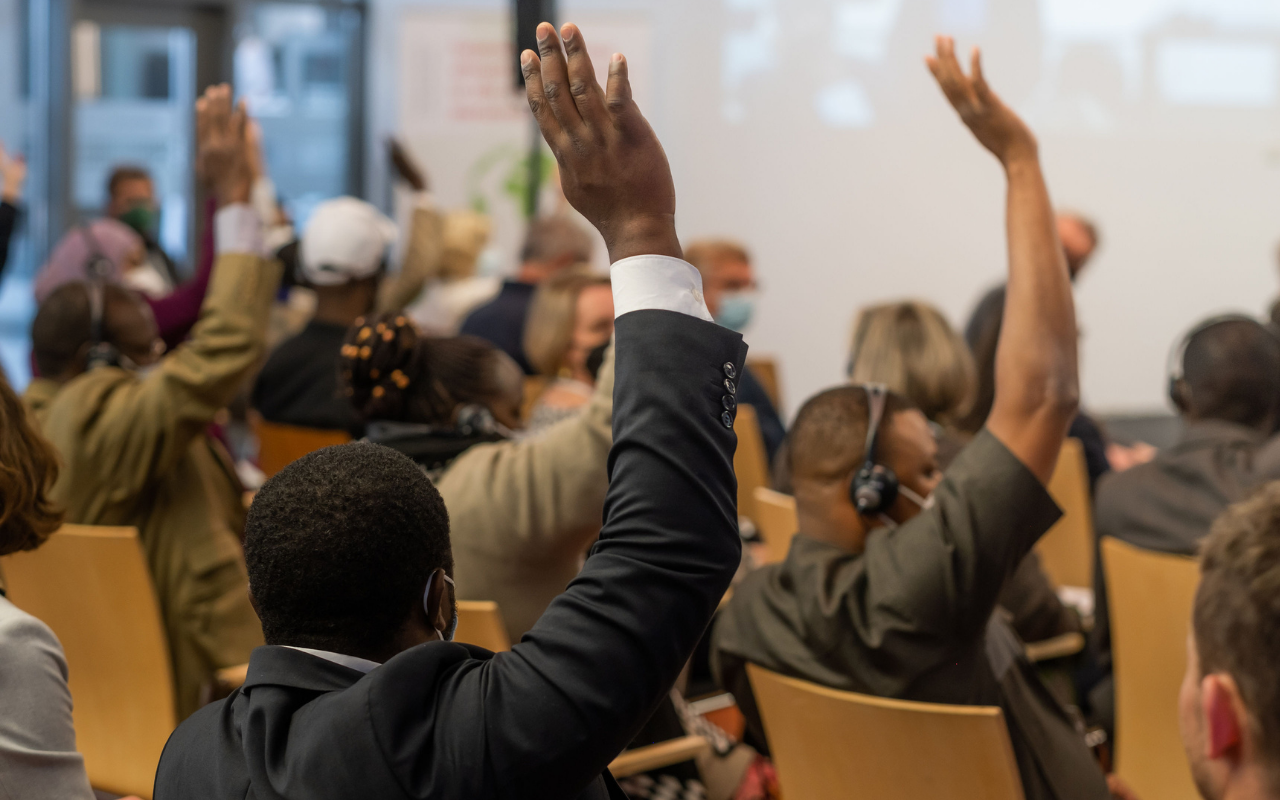
Participants in a conference raise their hands to engage in a discussion on shaping food systems.

‘Invite yourself’ – Farmers organisations as key stakeholders of food systems

A Contribution by Andreas-Hermes-Akademie

The Andreas Hermes Academy (AHA) discusses the transformation of food systems with 30 representatives of farmers organisations.

Read more

Golden hay bales rest on a sunlit stubble field under a clear blue sky, evoking a tranquil rural landscape.

How farmers are facing the crisis

A contribution by GIZ

Russia's war against Ukraine and its impact on food, energy and fertiliser prices is worrying farmers all over the world. Young farmers, farmer organisations and politicians from Kenya, Chad and Ukraine tell their stories and what keeps them in agriculture.


Read more

An aerial view of a rural village showcases a network of dirt roads winding through houses and greenery.

“We have to focus on sustainability”

An interview with Karen Mapusua

Karen Mapusua, President of IFOAM Organics International Network, on the danger of the current fuel crises and inflation to loose track in sustainablity, why organic farmers should be heard and how the word “crisis” has a very different meaning where she lives in Fiji.

Read more

A man in a suit speaks at a podium under a colorful tent during a Farmers Day event.

Governor's Day with Farmers – For more discussion with local actors

A contribution by William Onura and Larissa Stiem-Bhatia

In agriculture it is important to include political stakeholders in the discourse. To build the bridge between practical application and political action, the think tank TMG launched the Governor's Day with Farmers in Kakamega County, Kenya. Now it took place for the second time. But what are the goals and benefits of the Governor's Day?

Read more

A woman in a colorful dress and hat works with a hoe in a vast, barren field under a cloudy sky.

Farmers' organizations want to be involved in designing agricultural policy

An interview with Kolyang Palebele

Four interviews kick off the relaunch under the new name „Food4Transformation“, asking the same questions from different perspectives. "Women and young people need access to land. And they need financial support to cultivate this land." - says Kolyang Palebele, President of the Pan African Farmers Organisation (PAFO).

Read more

A man waters crops in a sunlit field using a green watering can, promoting sustainable agriculture practices.

Strengthening the market linkages of smallholders in the face of global supply shocks

A Contribution by Niladri Sekhar Bagchi

The consequences of the Russian invasion of Ukraine have enabled many countries to open up new export markets for their agricultural goods. However, smallholder farms have been largely left out. Drawing on his experience in India, our author gives a brief overview of how this can be changed.

Read more

Vibrant Abidjan market scene with vendors balancing colorful fruits on their heads, creating a lively atmosphere. | © GIZ Toni-Kaatz-Dubberke

Young farmers as custodians of transformation

An Interview with William Madudike

How can rural economies become viable and modern? William Madudike, youth representative of the Zimbabwe Farmers Union (ZFU) and a potato farmer himself, examines this question. He argues that the whole rural economy and actors from producers to consumers need to be considered. An interview on the initiative role of youth.

Read more

A woman in a blue headscarf carries freshly harvested onions in a vibrant field, showcasing sustainable solar irrigation.

Learning from Each Other

An Interview with Dr. Jacqueline Mkindi

Partnerships are needed to face the multiple shocks for food systems. This is what Dr. Jacqueline Mkindi, president of the Agriculture Council Tanzania (ACT) and CEO of the Tanzanian Horticulture Association (TAHA) states.

Read more

A woman in a pink headscarf and floral dress stands confidently in a lush garden. | © Claudia Jordan

Stick together and learn from each other

By Claudia Jordan

During the Women Leadership Programme in May 2024, around 20 women from African countries and Germany met again for a one-week workshop in Bavaria, Germany to become fit for leadership in their organisations. One topic that concerns the women across countries is climate change, but also violence against women and their discrimination in agriculture.

Read more

A person in a yellow shirt holds a tray of eggs, smiling inside a chicken coop filled with hens.

Cultivating tomorrow

A Contribution by GIZ

Africa’s largest youth generation has the potential to transform agriculture sustainably. Young entrepreneurs like Febelsa in Mozambique are building agricultural businesses that fuel local growth.

Read more

A woman in a red headscarf observes young plants growing in a greenhouse, tending to them carefully.

Uprooting the Norm

A Contribution by GIZ

As a passionate social scientist and entrepreneur from Malawi, Ngabaghila Chatata knows that she can overcome any challenge. Her story stands out in a country faced with high unemployment, particularly in its rural areas. As the managing director of Thanthwe Farms, she has set out to inspire the next generation of young agripreneurs – proving that successful business starts with the right mindset, not only capital.


Read more

A diverse group of women in casual attire smiles together outdoors, celebrating unity and community spirit.

Where Goats Listen to the Radio

A Contribution by GIZ

German and Ugandan women farmers come together in Mecklenburg-Vorpommern to exchange experiences – from modern milking systems to the challenges of women's participation in agricultural decision-making. Amid goats, lavender ice cream, and engaging discussions, one thing becomes clear: women can achieve great things together, across borders and generations.

Read more

A woman sorts cocoa beans in a wooden tray, wearing a colorful floral shirt and traditional patterned skirt.

"We didn't even make it halfway"

Interview with Claudia Brück and Torben Erbrath

The demand for fair-trade cocoa is growing – but how is the industry responding? In an interview, Claudia Brück, Executive Board Member of Fairtrade Germany, and Dr. Torben Erbrath, Managing Director of the Federal Association of the German Confectionery Industry, discuss progress as well as challenges, and why real change can only be achieved through long-term commitment along the entire supply chain.

Read more

A group of women stands smiling on a lawn in Herrsching am Ammersee, surrounded by lush greenery and a building.

"We want to change the narrative of rural women"

A Contribution by GIZ

Development cooperation doesn't resonate in Germany? The Bavarian rural women have a different story to tell. A visit to a training session with female smallholder farmers from Kenya, Zambia and Uganda in Bavarian Herrsching am Ammersee.

Read more

The white paper cover on a green gradient background discusses financing agrifood systems for sustainable development.

Financing Agrifood Systems for People, Planet and Prosperity

A Contribution by Global Donor Platform for Rural Development

The Global Donor Platform for Rural Development has recently published a new White Paper titled “Financing Agrifood Systems for People, Planet and Prosperity.” It outlines a practical agenda to unlock the capital, partnerships, and innovation required to drive change at scale.

Read more